
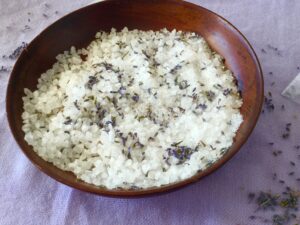
Beautiful Bath Salts and Sensational Soaking Salts
My Background and Experience
Hi, I am Yewande Rolph. I am the founder of Awards-winning Natural Fragrance Company Limited with the intent to Enhance Your Well-Being Naturally! Designed over 300 different natural environmentally friendly products including beautiful bath salts (sensational soaking salts). Bespoke mood boosting natural goods and services crafted to enable rest, relaxation, restoration, and sleep. Advantageous demonstrations, team building days, talks, coaching sessions, subscriptions, and workshops are also arranged.
What are Bath Salts (Soaking Salts) made of?
Bath salts (soaking salts) are mainly made with water soluble mineral particles.
Three water-soluble mineral particles used to make bath salts (soaking salts) include: –
- Epsom salt consists of magnesium sulphate.
- Sea salt mainly composed of sodium chloride also contains other trace minerals – magnesium, calcium, and potassium. Sea salts are added to baths.
- Natural Pink Himalayan salts are also used to make bath salts (soaking salts). Pink Himalayan salts made up of about 94% of sodium chloride said to also contain 84 minerals and trace elements that should be highly beneficial for the body.
Benefits of Bath Salts (Soaking Salts) – why use them?
Why do we use bath salts (soaking salts)? “Father of medicine” Hippocrates encouraged other doctors to use sea water to heal various conditions.
Many of us use bath salts to improve a relaxing soak in the tub. However, bath salts (soaking salts) are professed to have many therapeutic and health benefits for people with the following conditions:
- Anxiety
- Arthritis
- Circulation problems
- Dry skin
- Eczema
- Headaches
- Insomnia
- Itchy skin
- Muscle pain
- Psoriasis
- Stiff joints
- Stress
Why make your own Bath Salts (Soaking Salts)?
- Fun: Gain the skilful practice of sourcing the quality ingredients yourself. You would understand why those actual ingredients are included.
- Address any skin issues: If you or family members have sensitive or sensitised skin, you know what the actual natural ingredients are and where they came from. May people approach me as they have allergies, which has negatively affected them. Making own products has been helpful as they have been able to carefully use the items they made.
- Pleasant: Bath salts (soaking salts) are designed to clean the skin naturally and gently.
- Bespoke: Bath salts (soaking salts) you make can be adopted to your liking and specification. When you make then again, they can be improved to your satisfaction. You can learn by trial and error.
- Nice present: You can craft a lovely gift – something special for a friend that is not found on the high street. An item that you know that they would want, like & use.
- Cost effective: It may be possible to use what is already in your home to make bath salts (soaking salts).
- Simple: Making bath salts (soaking salts) can be as simple or complex as you want it to be. You can decide. Some bath salts just contain Epsom salts, nothing else. I found some bath salts that are just sea salt infused with a pure essential oil. Some bath salts only have pink Himalayan salts.
- Fulfilling: Can improve feelings satisfaction that you made something tangible that you can see, smell and touch.
- Worthwhile: making bath salts (soaking salts) may be used as an enjoyable mindfulness activity that takes our attention away from negative things when we focus on the tasks in hand.
- Community: You can build good rapport when crafting with friends and neighbours. Bath salts can also be made in a group as a team building, social activity. Members of a women’s group nearby regularly meet make things together. If not in person, they meet on-line. I previously ran a workshop for U3A and got the following comment from Christine, one of the organisers “I enjoyed the workshop run by Yewande Rolph”.
- Environmentally friendly: The bath salts (soaking salts) glass containers can re-used, recycled, and hopefully repaired. Therefore, reducing impact on the eco-system.
- Hobby: Making bath salts (soaking salts) can develop into a worthwhile regular pastime.
- Raise funds: Some people make bath salts (soaking salts) look professional to fund raise for a charity or good cause. For instance, I know a lady who is a member of “knit & natter” they meet every fortnight to knit things for charity.
- Emulate a Spa – Bath salts (soaking salts) are used as therapeutic spa treatments. Put the bath salts in your bath and imagine being in a beautiful Spa.
Other Ingredients added when making Bath Salts
Pure essential Oils (pure concentrated plant extracts).
Add 5 to 10 drops of pure essential oil to 100g of bath salts (soaking salts), mix thoroughly with clean wooden stick.
For example:
Pure essential oil of Lemon – with refreshing properties.
Pure essential oil of Marjoram – with muscle relaxant effects.
Pure essential oil of Neroli (Orange Blossom) – with stress relieving properties.
Pure essential oil of Tea Tree – with antiseptic effects.
Dried botanicals add about one teaspoon to 100g of bath salts (soaking salts), mix thoroughly with clean wooden stick.
If adding dried botanicals, be careful of them blocking the bath plug hole.
For example:
Dried lavender flowers – purple flowers look great, smell wonderful and can calm nerves.
Dried rosemary leaves – with distinctive aroma and should stimulate circulation.
Dried tarragon leaves – green herbal addition and used as general tonic.
How to make your own Bath Salts – step by step guide
Five steps
Step 1
Design the bath salts (soaking salts) to decide ingredients and container to use.
I usually use coarse sea salts, pink Himalayan salts, and pure essential oil – 100g container.
Step 2
Fill the container half full of the first ingredient.
In my case, coarse sea salts
Step 3
Then fill the container near the top, first rim with the other ingredient(s).
In my case, pink Himalayan salts is the other ingredient.
Step 4
Carefully add 5 to 10 drops of pure essential oil to 100g.
I enjoy really using white grapefruit pure essential oil.
Step 5
Carefully mix well. I usually shake the container.
How to use Bath Salts (Soaking Salts) you made – Suggested self-care routine:
- Add about one tablespoon to running bath.
- Check bath is wonderfully warm, not too hot.
- Lie in bath to enjoy the warmth and natural aroma.
- Whole body should be totally relaxed.
- Release any physical tensions you may notice.
- Hold your belly with both hands.
- Take some deep relaxing breaths from the belly to fill the lungs.
- Aim to rest and soak in the bath for around 20 minutes.
- Keep bath salts lid tightly closed when not in use.
Other great uses of Bath Salts (Soaking Salts)
One dessertspoon can be put in a wide, shallow bucket half filled with warm water for soaking the feet, hands, or elbow.
Cautions & Disclaimer:
The bath salts (soaking salts) are not intended to diagnose, prevent, treat, or cure any diseases or conditions. If sensitive, always do a patch test. They are for safe external use only in the bath. Do not ingest. Do not use if allergic to any of the ingredients. Do not use bath salts on broken skin. Avoid contact with the eyes. Keep away from young children and pets.
Summary
Hope you enjoyed reading this blog. In this article, I go through ingredients, steps, and benefits of making natural soaking (bath) salts, not just in the bath. Do note if any symptoms persist, please consult your doctor as soon as possible. Please get in touch if you have any queries.